Water heaters
Why water heaters fail early in Elgin
The manufacturer says ten to twelve years. Around here, eight is a good run. Hard water is most of the reason, and two habits change the number more than the brand you buy does.
· 6 min read · Alexander Plumbing and Sewer
The short answer
The short answer
Elgin tap water runs roughly 250 to 350 ppm hardness. That mineral drops out of solution when heated and settles as scale on the bottom of the tank, insulating the burner from the water, driving up the metal temperature, and cracking the glass lining years ahead of schedule.
What scale does inside the tank
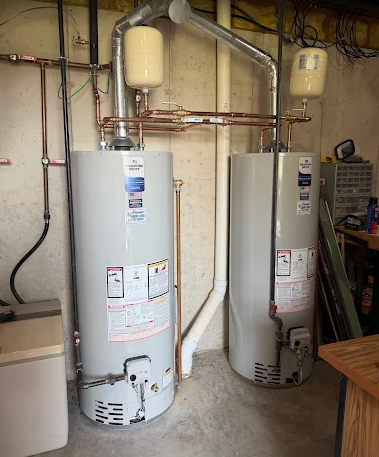
A gas water heater fires from underneath. The burner heats the steel bottom, the steel heats the water. Put half an inch of hardened calcium between those two and the heat has to force its way through an insulator, which means the steel itself runs far hotter than it was designed to.
Two things follow. The glass lining that protects the steel from the water expands at a different rate than the steel and starts to craze and flake. And the sacrificial anode rod — the magnesium or aluminum bar whose whole job is to corrode instead of your tank — gets consumed faster because the water chemistry is more aggressive to begin with.
Once the lining is compromised and the anode is gone, the tank is on borrowed time. A leak from the bottom seam is not repairable; that is a replacement.
How to tell it is happening to yours
Popping or rumbling during a heating cycle. That is water flashing to steam underneath the scale layer and forcing its way out. It is the single most reliable early sign.
Recovery is slower than it used to be. Two showers back to back used to be fine and now the second one goes cold. The burner is fighting the insulation.
Rusty water from the hot tap only. Cold runs clear, hot runs tinted. That is the lining, and it means the clock is well along.
Any moisture at the base. Check the drip pan. A seam leak starts as a stain, not a puddle.
The two habits that actually extend life
Flush it annually. Genuinely annually, not when you remember. Twenty minutes with a hose on the drain valve removes the sediment before it hardens into a shelf. Once it has hardened, flushing does very little — which is why people who start flushing in year seven report that it "did nothing."
Change the anode rod at about year five. This is the maintenance item almost nobody does and it is the cheapest life extension available. A rod costs less than a service call; a tank costs a great deal more.
If you are on well water or your fixtures are visibly scaling, whole-home filtration or softening pays for itself over the life of one and a half water heaters — and it protects the rest of your fixtures at the same time.
When replacement is the right call
Past year ten, with rumbling and slow recovery, we will usually tell you to plan the replacement rather than repair the symptom. A thermocouple or a heating element on a twelve-year-old tank is money spent on a unit that will not see year fourteen.
Under year eight with a specific failed component, repair it. Our water heater page covers what each option costs to run over the following decade, which matters more than the sticker price does.
How hard is Elgin water?
Most of the county lands between 250 and 350 ppm, which is classified as hard to very hard. It varies by which blend of imported and groundwater your district is serving that season.
Does a tankless heater avoid the scale problem?
It avoids the tank problem but not the scale problem — tankless units need descaling roughly annually here, and skipping it voids most warranties. They are a good choice locally, but only if the maintenance actually happens.
Can I flush the tank myself?
Yes, and you should. Shut off the gas or breaker, connect a hose to the drain valve, run it to a driveway or drain until it comes out clear. The one caution: on a tank that has never been flushed, the valve sometimes will not reseat afterward. If yours is over eight years old and untouched, have it done on a service visit instead.
Keep reading
More from the blog.
Is a water softener worth it here?
For most Elgin houses, yes — but not for the reasons the door-to-door salesperson gives. The plumbing savings are real; the skin-and-hair pitch is not why it pays for itself.
Read the postDoes liquid drain cleaner actually work?
Short answer: sometimes, on hair and soap in a bathroom sink. On a kitchen line, a main line, or anything you have poured it into twice already, it is doing more harm than the clog.
Read the postAll plumbing services
What we do, what it costs, and how each visit actually goes.
Browse servicesA plumbing problem should
not become a renovation.
If it is safe, close the nearest shutoff valve, move belongings away from water, and tell us exactly what you see.