Drains
Does liquid drain cleaner actually work? An Elgin plumber's take
Short answer: sometimes, on hair and soap in a bathroom sink. On a kitchen line, a main line, or anything you have poured it into twice already, it is doing more harm than the clog.
· 5 min read · Alexander Plumbing and Sewer
The short answer
The short answer
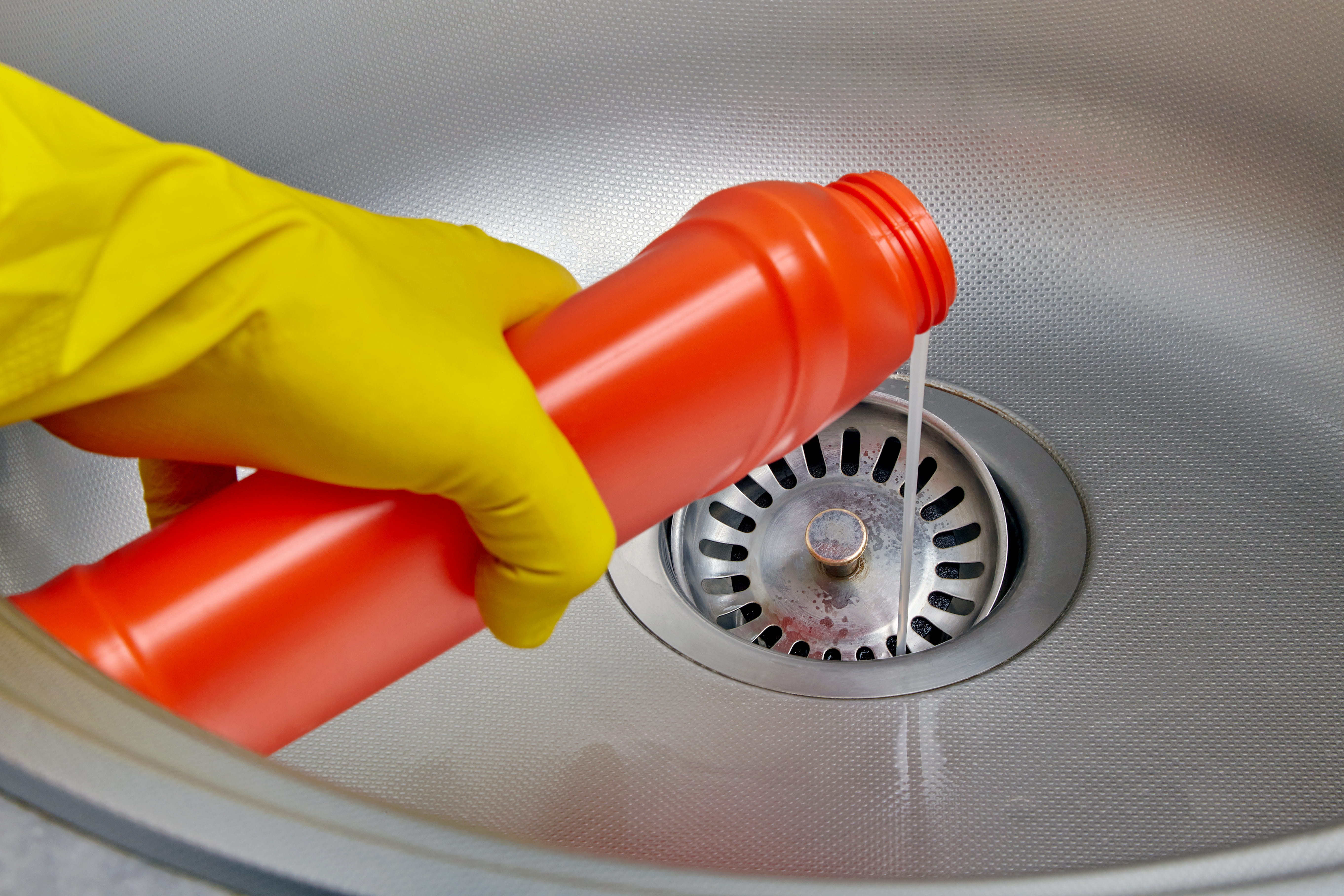
Liquid drain cleaner works on soft, shallow clogs — hair and soap within a foot or two of a bathroom sink drain. It does not work on grease, roots, or anything in a main line, and repeated use corrodes older pipe and creates a caustic pool a plumber then has to work in.
What is actually in the bottle
Most supermarket drain cleaners are one of two things: a caustic (sodium hydroxide, i.e. lye) or an oxidiser (sodium hypochlorite, i.e. bleach, sometimes with sulfuric acid in the heavy-duty versions). Both work by chemically breaking down organic material and generating heat while they do it.
That mechanism tells you exactly where they help and where they do not. Hair, soap scum, and light organic film are organic and sitting in standing water — the chemical reaches them and dissolves them. Grease that has cooled and hardened along thirty feet of kitchen line is also organic, but the chemical never reaches most of it before it dilutes. Tree roots are organic and the chemical will not touch them in any meaningful quantity.
The three times it makes things worse
Old galvanized or cast iron pipe. Plenty of Elgin homes built before 1960 still have it, and it is already thinned by decades of corrosion. Caustic cleaner accelerates that. We have opened lines in older Elgin tracts where the failure point was visibly the spot a homeowner had been treating for months.
A line that is fully blocked, not slow. If nothing is draining, the cleaner does not go down to the clog — it sits in the trap and the standing water above it. Now the fixture holds a few inches of caustic liquid, and whoever opens that trap gets it on their hands and forearms. Tell your plumber if you have poured anything in; we would much rather know.
Anything past the fixture. If two or more fixtures are slow at once, the problem is in the branch or the main, not under the sink. That is a sewer and rooter call, and no amount of bottled cleaner reaches it.
What we do instead
For a single slow fixture, mechanical clearing beats chemistry every time — a small auger through the trap arm takes about fifteen minutes and physically removes the material rather than partially dissolving it and leaving the rest to re-form.
For a recurring clog, the useful question is not "how do we clear it" but "why does it keep coming back." That is what a camera is for. We run one on most repeat calls, and roughly half the time the answer is a belly in the line, a partially collapsed section, or root intrusion at a joint — none of which a clearing will fix for longer than a few months.
If you want the full picture on how we approach it, our drain cleaning page walks through the visit step by step.
The honest recommendation
Keep a drum auger in the garage instead. It costs about what three bottles of cleaner cost, it works on the clogs the cleaner works on, and it works on several the cleaner does not. Use enzymatic maintenance products if you want something poured in — they are slow and they will not clear an active blockage, but they will not eat your pipe either.
And if you have already poured cleaner in twice with no result, stop. The third bottle is not the one that works.
Is it safe to use drain cleaner in a home with a septic system?
No. Caustic and bleach-based cleaners kill the bacterial colony the septic tank depends on. Use mechanical clearing or an enzymatic product instead.
I already poured drain cleaner in. What should I tell the plumber?
Tell us before we open anything — which product, how much, and how long ago. It changes how we protect ourselves and how we handle the standing water, and it is not something we will judge you for.
Will drain cleaner clear tree roots in a sewer line?
No. Root-killing foams sold for this purpose can slow regrowth after a line has been mechanically cleared, but nothing poured down a drain will remove an established root mass.
Keep reading
More from the blog.
Is a water softener worth it here?
For most Elgin houses, yes — but not for the reasons the door-to-door salesperson gives. The plumbing savings are real; the skin-and-hair pitch is not why it pays for itself.
Read the postWhy does my toilet keep running?
Most of the time it's a worn flapper, an inexpensive part you can often replace yourself. Here's how to find the cause with a simple dye test, and when it's time to call a plumber.
Read the postAll plumbing services
What we do, what it costs, and how each visit actually goes.
Browse servicesA plumbing problem should
not become a renovation.
If it is safe, close the nearest shutoff valve, move belongings away from water, and tell us exactly what you see.